
Data center construction is growing rapidly, while requirements related to environmental impact, schedules and technical efficiency are becoming increasingly demanding. Alongside energy and water use, the question of what data centers are built from, and how they are built, is becoming increasingly important.
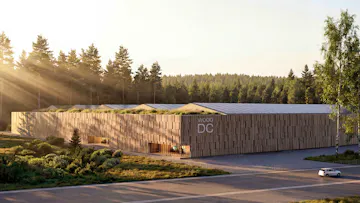
From SRV’s perspective, one answer lies in wood. At the LUMI AI Factory data center currently under construction in Kajaani, CLT solid wood is being used as the building material for the shell of the data hall. The project is being implemented in an existing former paper mill hall, which also brings a circular economy perspective into the project.
The LUMI AI Factory data center continues SRV’s long-term development work in wood construction. The company’s expertise is based on demanding wood construction projects, such as the Wood City block in Jätkäsaari, Helsinki, and Event Centre Satama in Kotka. The expertise gained in these projects is now also being applied to data center construction.
“Wood is no longer a special solution in industrial construction. Increasingly, load-bearing structures can be built from wood because it combines speed, cost efficiency and a smaller carbon footprint”, says Mikko Leino, Director of Wood Construction Development at SRV.
Prefabrication speeds up construction
In a data center, data halls, technical spaces, cabling, cooling, ventilation and fire safety solutions must work seamlessly together. This is why the design of a wood-based data center starts with the building’s functional and technical requirements, not merely the choice of material.
The wood-based data center concept developed by SRV is particularly well suited to buildings of one to four storeys, and it does not lock the project into a single supplier or technical solution. Data halls, technical spaces and system routes are designed as part of the same overall solution from an early stage.
“A high degree of prefabrication supports this approach. When load-bearing structures, wall and roof elements, openings, penetrations and fixing points are designed as far as possible in factory conditions, the construction phase on site is shortened and the quality of delivery improves”, Leino notes.
At the same time, taking system routes into account already during element production reduces the need for changes on site and makes it easier to coordinate building services, cooling and electrical systems.
Wooden structures can be implemented in several ways
A wood-based data center does not mean a single ready-made structural type. The structural solution can be selected according to the scale, purpose and technical requirements of the project.
Wooden structures can be implemented using a variety of different materials, and wood can be combined with other materials where appropriate.
“A solid wood frame enables fast delivery based on prefabricated structures on an industrial scale. In data centers, this expertise is combined with technical design, where every penetration, route and spatial reservation matters”, Leino says.
Wood reduces the carbon footprint
When discussing the environmental impact of data centers, attention often focuses on energy consumption. However, emissions from construction materials are also a significant part of the overall picture, which means the frame solution has a major impact.
Wood construction reduces the carbon footprint of construction and also brings a carbon storage effect to the project. Solid wood structures bind carbon throughout their life cycle.
“The built environment accounts for around 40 per cent of global carbon dioxide emissions. As a significant share of emissions comes from materials, the frame solution is one of the most effective ways to influence the overall impact”, Leino summarises.
Wood construction also strongly supports the circular economy.
“Buildings can be designed for adaptability from the outset. In a solid wood frame, the circular economy is essentially built in: when the detailing is designed correctly, the structures can be dismantled and reused. This means that, during its life cycle, the building could be converted, for example, into a daycare centre or another type of business premises", Leino says.
Wood construction brings quality and competitive advantage to data centers
In data centers, wood construction affects not only the frame solution but also the building’s architecture and identity. Wood enables finished interior surfaces as well as façades that can make use of wooden shingle cladding, thermally modified pine or prefinished façade elements, for example.
“Wood construction is no longer just a responsible choice. In data centers, it can also be a sound business decision: construction is faster, the site phase is shorter, prefabrication improves quality, and material choices reduce the project’s carbon footprint”, Leino emphasises.

Build your data center in Finland with SRV
SRV specializes in mission-critical data centres that combine cutting-edge technology, security, and responsibility. From concept to commissioning, we provide end-to-end delivery as a single trusted partner.