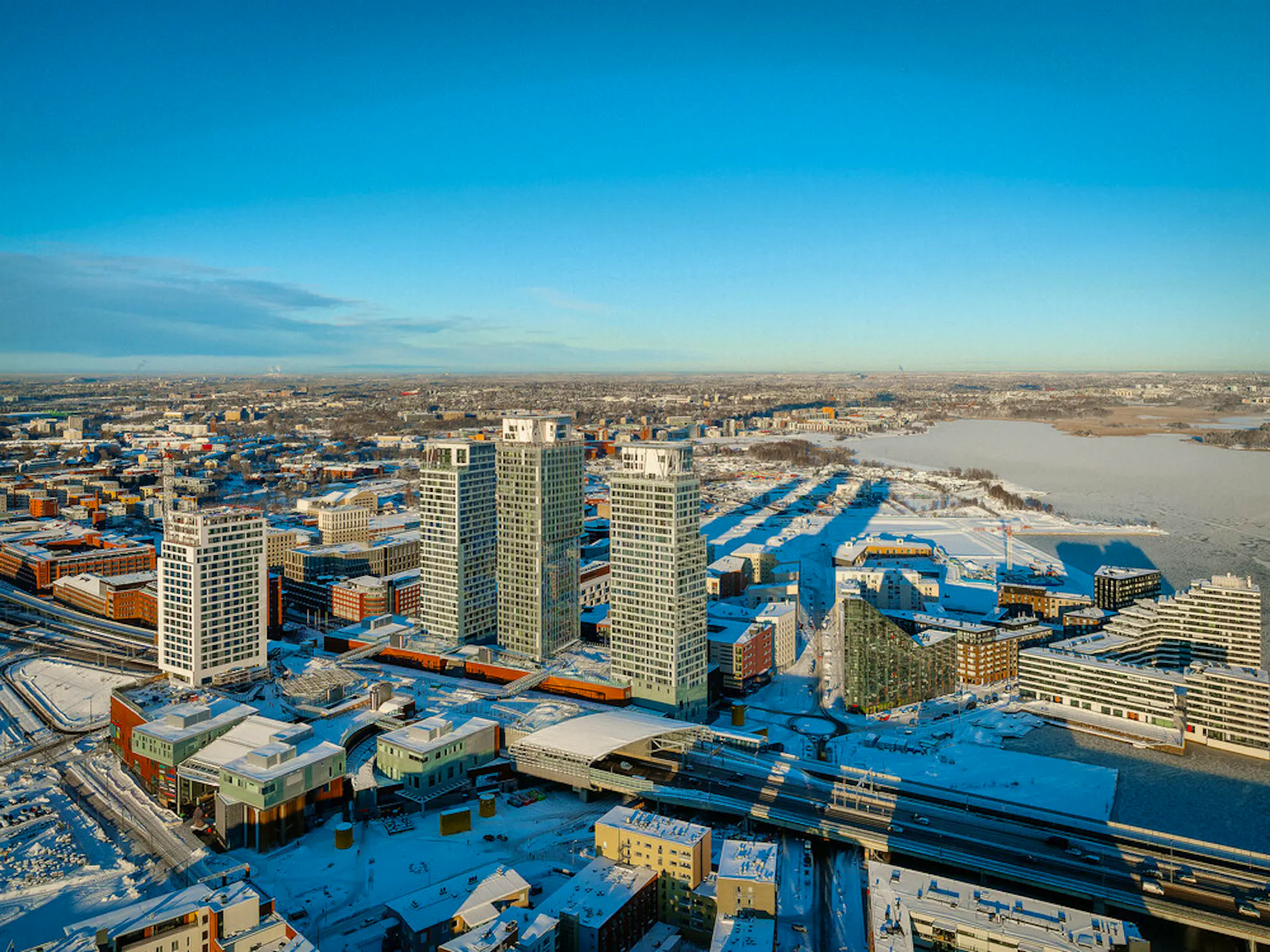
Verified responsibility supports property value throughout the lifecycle
When responsibility is verified instead of assumed, the investment becomes more predictable.
Environmental certifications, EU Taxonomy requirements and lifecycle carbon management help meet the growing expectations of investors, financiers and tenants. Verified responsibility can enhance a property's attractiveness in financial markets, strengthen its leasing potential and support the preservation and verification of value throughout the asset’s lifecycle.
A partner that understands investor objectives
SRV has delivered projects for both domestic and international real estate investors. We combine environmental certifications, EU Taxonomy requirements, carbon footprint assessments and lifecycle-smart design into a comprehensive approach that supports long-term property value and sustainable investment returns.
At SRV, environmental certifications are an integral part of lifecycle-wise property development. We take a holistic approach to sustainability, considering not only environmental impacts but also usability, energy performance, maintainability and value retention throughout a building’s lifecycle.
How does SRV implement certification requirements in practice?
Environmental certifications provide an independent and internationally recognized method of verifying a building’s sustainability performance. They facilitate asset comparison, support sustainable finance objectives and reduce investment-related uncertainty.
Certification requirements guide planning, construction and material choices from the earliest stages of a project. SRV’s lifecycle-smart approach is based on solutions that improve environmental performance, user experience and long-term value preservation.
How we deliver certified sustainability in practice
Energy and Environmental Efficiency
We invest in energy-efficient solutions, renewable energy sources and intelligent energy management. Energy efficiency, emissions reduction and carbon footprint management are central to SRV’s lifecycle-wise approach and to the objectives of environmental certification schemes.
Resource Efficiency and Circular Economy
Efficient waste sorting, recycling and responsible material selection are an essential part of our construction practices. We favor durable materials and, where possible, solutions containing recycled raw materials, supporting the objectives of both BREEAM and the Rakennustieto Environmental Classification (YL).
Healthy Indoor Environments
Indoor air quality and occupant well-being are considered from the design phase onwards. We use low-emission materials and solutions that promote healthy, comfortable and user-friendly indoor environments. Both LEED certification and the YL classification emphasize healthy indoor conditions that enhance user satisfaction, attractiveness and long-term value.
Accessible and Attractive Locations
We develop projects in well-connected locations close to services, public transportation and major transport links. Location plays a significant role in LEED assessments, while good accessibility also increases a property's attractiveness for occupiers and investors.
Biodiversity and Stormwater Management
Our projects take biodiversity and nature-based stormwater management solutions into account. These measures help reduce environmental impacts and contribute to sustainable and attractive urban environments.
Responsible Homes Designed for Finnish Conditions
We seek the Rakennustieto Environmental Classification (YL) for the majority of our developer contracting residential projects. Developed specifically for Finnish conditions, the YL classification helps ensure energy efficiency, a low carbon footprint, healthy indoor environments and responsible material choices. This enables the creation of homes that remain sustainable for both residents and the environment well into the future.
Environmental certifications used by SRV
LEED (Leadership in Energy and Environmental Design) is a globally used environmental certification system originally developed in the United States. It evaluates building sustainability across areas such as energy efficiency, water consumption, site selection, material choices and indoor environmental quality.
LEED emphasizes sustainability throughout the entire building lifecycle, from design and construction to operation. It is the most widely recognized environmental certification internationally and is particularly well known among global real estate investors. LEED provides an independent way to verify sustainability performance while enhancing a property's attractiveness to investors, occupants and financiers.
BREEAM (Building Research Establishment Environmental Assessment Method) was developed in the United Kingdom and is one of the world’s oldest environmental certification systems. It is particularly widely used throughout Europe.
BREEAM assesses buildings from a comprehensive sustainability perspective, including energy and water consumption, materials, transport accessibility, biodiversity, waste management, indoor environmental quality and building management practices. Certification levels are awarded based on the number of credits achieved, with higher ratings demonstrating ambitious sustainability performance.
The Rakennustieto Environmental Classification (YL) is a Finnish sustainability assessment system developed specifically for the local regulatory environment, construction practices and market needs.
The classification evaluates environmental performance and user experience through criteria such as energy efficiency, carbon footprint, indoor climate, responsible material choices and technical functionality. Its purpose is to guide projects towards lower-carbon, healthier and longer-lasting building solutions.