Details
Nokia Arena has taken Tampere to a new level as a city of events, congresses and experiences. Built as part of Tampere Deck, the arena brings an international-scale event venue to the heart of the city, strengthening the appeal of both the city centre and the wider region.
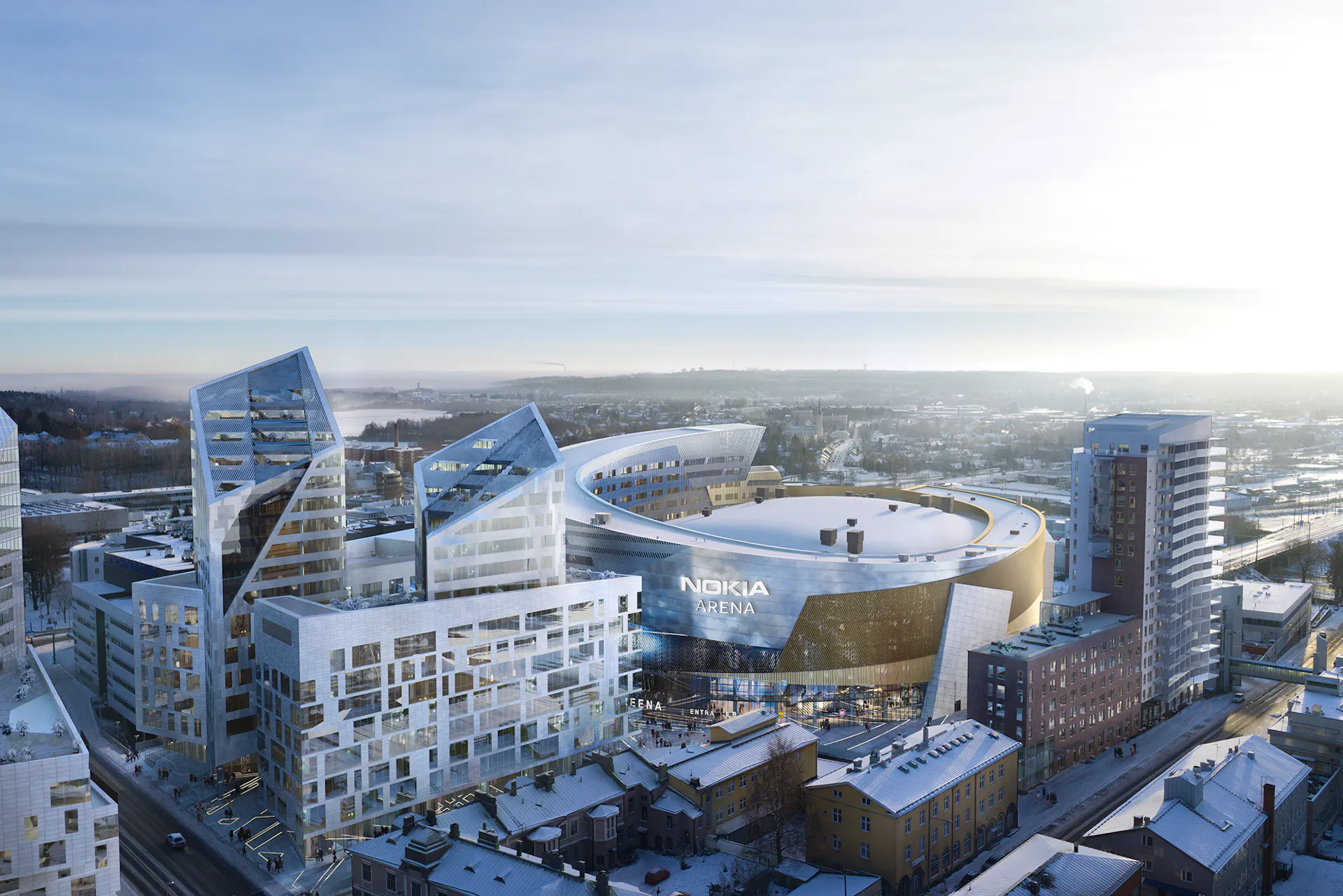
Nokia Arena is part of Tampere Deck, which forms a striking landmark in the heart of the city. In addition to the arena, the versatile entertainment complex includes Veikkaus Casino, a Lapland Hotels hotel, retail and office spaces, a practice rink, a car park and two residential towers.
Nokia Arena hosts events for up to 15,000 people throughout the year. Construction of the arena, which has won the prestigious Human-CentriCity Award, began in autumn 2019 and its official opening was celebrated in December 2021. The investors in the project are LähiTapiola, OP, Ilmarinen, SRV and the City of Tampere.
A versatile arena for events throughout the year
Nokia Arena can be flexibly adapted for a wide range of events, from congresses for a few thousand people to major concerts, and from ice hockey matches to spectacular shows. The arena accommodates 13,000 spectators for ice hockey matches and up to 15,000 for concerts.
The total area of the southern deck is 21,500 square metres, while the arena itself has a gross floor area of 64,500 square metres. The ice surface of the modern ice hockey rink measures 1,725 square metres.
Nokia Arena was built largely by local expertise. At its peak, 5,000 people worked on the project, around half of them from the Pirkanmaa region

Distinctive architecture
The rising profile of the Deck’s tower buildings and Daniel Libeskind’s modern architecture have given Tampere’s skyline a new and distinctive look.
The design of the arena and the entire Deck area was divided between two architectural practices. Studio Libeskind was responsible for the area’s urban design and massing during the zoning phase, as well as the façade colours, materials and placement of façade signage during construction. Aihio Arkkitehdit designed the building’s interiors and prepared the detailed façade drawings in accordance with Studio Libeskind’s guidance.
The arena’s façade panels are aluminium finished in three different tones, shimmering in shades of bronze, champagne and silver. Some of the metal cladding was produced in Finland. Metal grilles create twisting forms across the façade, while the deck is finished with black concrete paving stones and grey granite slabs from Kuru.

Sustainability at the heart of design
Sustainability was taken into account from the design phase of Nokia Arena, and the building achieved the international LEED Gold environmental certification.
The arena uses wind power and other renewable energy sources. Cooling is provided using cold groundwater from Lake Näsijärvi, while the ice is produced using a modern CO₂-based system.
Its central location at a public transport hub enables visitors to arrive by public transport, bicycle or on foot, helping to reduce the carbon footprint of events. Nokia Arena provides Tampere with a world-class setting for a wide range of events and brings new vitality to the heart of the city.m.

Nokia Arena provides Tampere with a world-class stage for congresses and trade fairs, while bringing new vibrancy to the city centre.
International recognition for Nokia Arena
Nokia Arena received international recognition by winning the prestigious Human-CentriCity Award in the 2024 Seoul Smart City Prize competition. The award-winning solution enhances the visitor experience at the arena through LG smart displays.
The award recognises projects that combine technology and human-centred design in a way that promotes digital inclusion and supports people’s everyday lives. The competition is part of a programme by the World Smart Sustainable Cities Organization (WeGO) and the City of Seoul.

When you build, build wisely
SRV helps you take your project from idea to completion. By listening to our customers, we build spaces where functionality, costs and sustainability are balanced throughout the building’s entire life cycle.
References

Satama Areena

Lahti City Hall